

Rather than imagining the Training Scale as six separate steps, it helps to see it as three foundations that keep deepening over time. Rhythm, suppleness, and connection are not just “first” — they are the soil. They are where the horse’s shape begins to grow, where the back loosens, the energy starts to recycle, and balance becomes possible.
Out of that same soil, the next three grow — impulsion, straightness, and collection. These don’t need to be added as something extra. They emerge because the foundations are continuously refined.
In other words, you don’t bolt new pieces on top of what you already have; you keep working the rhythm, suppleness, and connection until they flower into impulsion, straighten themselves into balance, and condense into collection.
We begin with rhythm — the horse’s metronome of trust. Not speed, but crystal-clear regularity – footfalls so even you could set your watch by them, whether in walk, trot, or canter. When the rhythm of each gait is predictable, the nervous system settles, muscles release, and the back begins to swing.
This is the true doorway into suppleness, not left-rein/right-rein noodling but suppleness as a spinal quality: the topline lengthens, the back swings, range of motion increases, and energy can circulate through the body without hitting a brace.
That circular flow—hindlegs → back → topline → neck → hand → back into the body—is the loop. When the loop is unbroken, the horse carries you; when it’s broken, you end up carrying the horse. Connection is simply that loop made tangible in your hand. Picture your reins as a pulley system: one rein asks, the other shapes and contains. Both share load so the “scales” never dump weight onto one side. Even a micro-yield is yielded into the support of the partner rein.
This is where riders stop “moving a head” and start organising a body—because rein aids act through the hyoid chains into the thoracic sling and topline. Used correctly, they lengthen the topline and shorten the wheelbase so weight is shared evenly across all four feet – the lever-path of real anatomy.
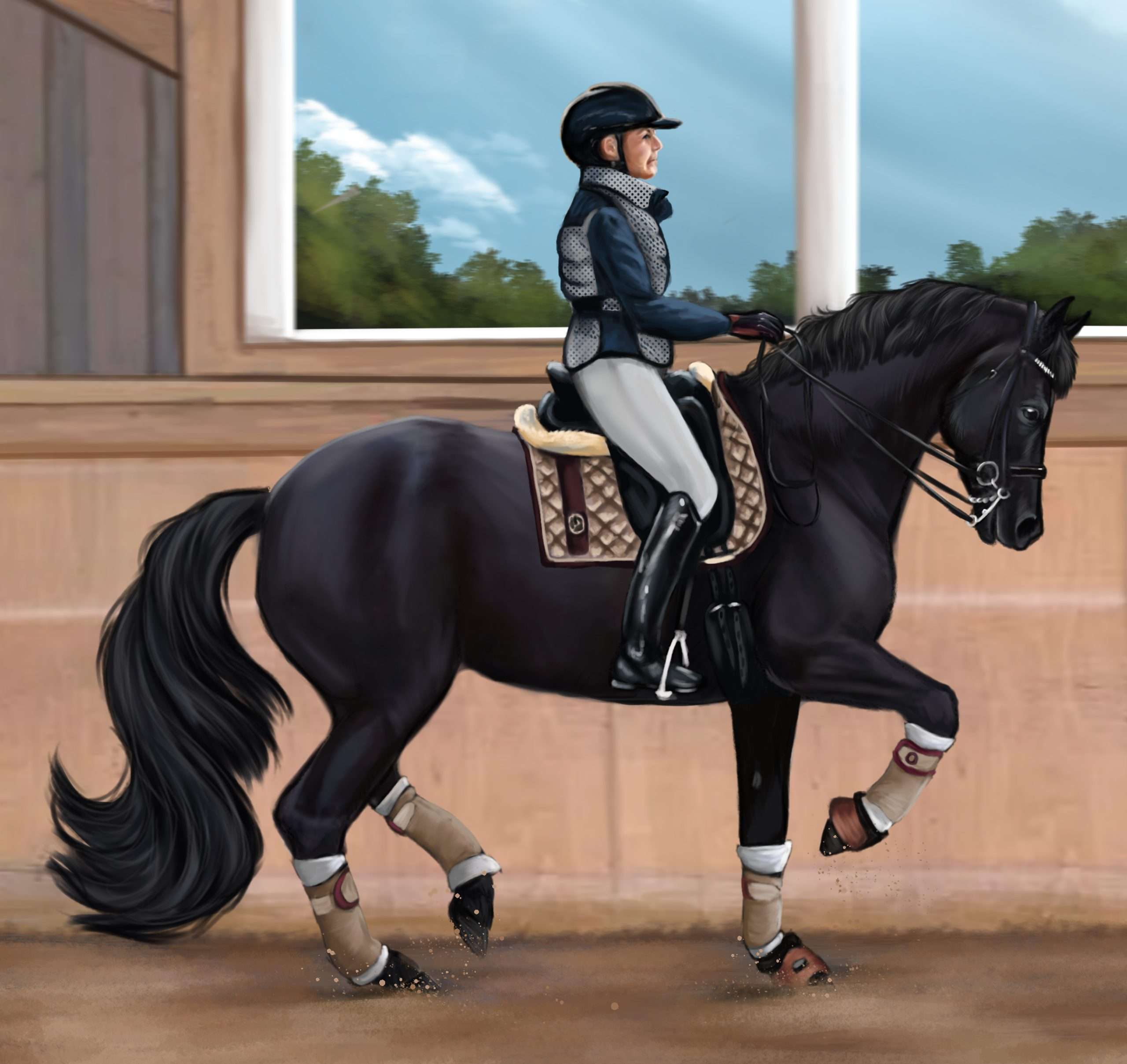
When rhythm, suppleness, and connection are genuinely in place, the horse’s body starts to change shape. The back broadens, the withers begin to lift, and the shoulders stand more upright in front of the hips.
At this stage, the poll may not — and in most horses probably will not — be the highest point. That is not something to worry about. The aim here is not to “place” the poll but to establish the first honest loop of connection, where the backbone begins to expand and energy circulates freely.
Given most horses’ anatomy, the wheelbase is not yet short enough for the poll to rise to the very top; that comes later as the training scale develops into impulsion, straightness, and collection. The important thing now is to let the body organise so the shape grows from underneath, knowing that the poll will find its place in time.
Now, make this loop bigger and clearer and you start to feel what classical texts call impulsion. Not “more gas”; more spring.
Very importantly, this spring must not come at the expense of what is already there. It is not about slowing the steps down, or making them shorter in order to find bounce. The full range of movement, the same clarity of rhythm, and the same ground cover must remain intact — and then the spring is added on top. Think of it as building more into the existing picture rather than swapping one quality for another.
When it’s correct the stride feels as big and free as before but now with added elasticity, as if the horse is riding on compressed air. You don’t kick this into being; you shape it with within-gait transitions—close the frame a few steps, open a few, never letting the wither drop or the rhythm blur. That “close–open” feels like gentle breathing inside the trot or canter.
Straightness follows for a beautifully unglamorous reason: a truly swinging back plus an honest connection makes it possible to organise shoulders in front of hips on any line.
If your “straight” horse falls over a shoulder the moment you leave the track, that wasn’t straightness—that was scaffolding. Test it. Ride off the wall onto a circle or diagonal. If balance and height of the wither stay the same, you are straight; if the line exposes leakage, fix the loop first back at the wall, then re-test. My riders know this as the “train tracks” check: head and neck centered in the chest, ears level, shoulders directly in front of the hind legs.
Collection is simply the loop at its most refined—shorter wheelbase without tension, longer topline without sag, elastic load shared over all four feet so you can add sit without losing swing. In that state, the poll floats because the thoracic sling is doing its job, not because we’ve held anything in place.
When you can close the frame, keep the wither up, change nothing in rhythm, and then re-open with the same purity – you’re in the neighborhood. This is why systems that protect the basics produce more consistent collection at the top: the judging and training cultures reward the ingredients (symmetry, throughness, shortened wheelbase with freedom), so riders are nudged to build bodies that can recycle energy under pressure— bodies that last.
From a sports-medicine angle, this is not philosophy; it’s load management. Dressage done as gymnastic physiotherapy distributes forces symmetrically, keeps tissues elastic, and reduces the chronic overloads that break horses down. Every micro-rebalance is a mobilisation. Every honest transition recruits postural muscle.
The topline acts as a shock absorber when it’s long; the sling protects the front end when you keep the wheelbase short and the shoulders upright. That’s why we say “dressage is medicine” and why the Training Scale, when ridden as one loop, is your daily rehab plan as much as it’s your path to Grand Prix.
How do you do this practically from the first stride?
- Set the metronome and protect it (count your strides!). Rhythm is the nervous system’s safety cue; without it, suppleness won’t show up.
- Ride for spinal suppleness, not long neck or moving the head. Suppleness is the back’s ability to travel the wave. If you feel “stuck, ” don’t kick into a brick wall; open the body to create an opening for your leg, then use it. Often the fastest door is a small rein-angle change that elasticises the hyoid chains and unlocks the sling. Only use your leg when there’s an open door.
- Treat contact as organisation, not decoration. Hands work as a pair—the ELE microaid keeps the shoulders square and the wither proud. Think mm, not cm; think shaping, not stopping. If one rein gets chatty and the other goes silent, your scales have tipped. Level them.
- Measure straightness by sustainability. Leave the wall. Does the same balance survive the harder line? If not, your straightness was a myth. Re-establish the loop on the wall, before trying again. Advanced riders: stress-test with three steps collect / three allow, then shoulder-in 10 m and out, watching for the wither to stay up and the rhythm to stay honest.
- Remember the picture follows the posture. If the poll is your first to-do, you’ll end up holding air. If the back is your first to-do, the poll will grow as a by-product. Every time.
A final word on rein aids and shaping, because this is where many riders either unlock the scale…or stall. The indirect rein in front of the wither is your quiet organiser of shoulders; the other direct rein is the anchor that prevents what you created from leaking away.
In half-pass, for example, the inside indirect rein shortens the inside of the body so the outside can lengthen, creating the correct arc; the outside rein defines the boundary so the energy stays recycling, not spilling out. This is leverage and angle, not strength; a finger can change a shoulder if the pulley is paired.
Where do the great riders fit into this?
Watch the work of the true masters and you’ll see the same loop. Their horses look carried by themselves because rhythm is unshakeable, backs are soft, contact breathes, and every “more” is just a cleaner, prouder version of the same basics. That is why when they “open” from collection, the trot grows taller rather than quicker, and the canter depart writes the whole chapter of the canter that follows.

this made my heart sing .. such great clarity and so many aha moments .. perhaps written a long time ago .. but thank you from today !!!!