
Understanding The Difference Between Reshaping And Just Creating A Frame
In dressage, few things cause more confusion than the frame.
We talk about “poll the highest point” as if it were the end goal, yet if all we do is lift the head, we end up with a picture, not a posture. The real art is in reshaping the body so that the poll rises as a by-product of true circular energy, not as a trick of the hands.
When a rider simply lifts the head, the movement is cosmetic. The hyoid chains tighten, the topline braces, and the back loses swing. You see a horse whose nose may be in the right postcode, but the spine behind it has gone missing. That’s the difference between decoration and medicine.
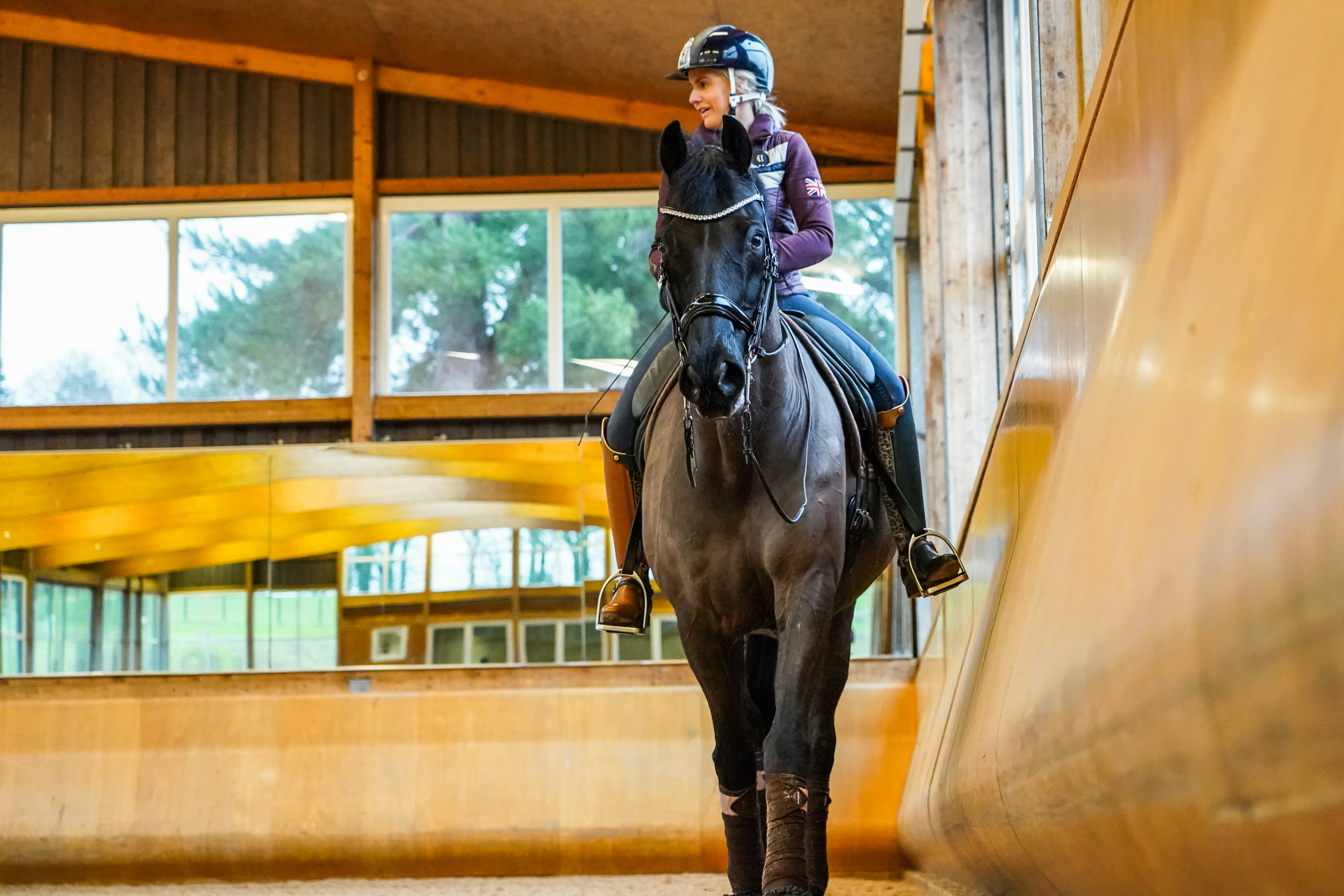
Contrast this with what happens when we reshape the body. The shoulders come upright, the wheelbase shortens, the back lifts, and the energy starts to recycle. This circular flow — hind legs stepping under, topline lengthening, withers rising — creates the poll as the highest point naturally. The neck doesn’t need to be held; it floats because the body underneath is carrying correctly. That is the frame as a consequence, not a command.
Think of it as a loop. If the horse is truly gymnastic, energy begins in the hind legs, travels forward through the swinging back, up into the topline, through the neck, and into the hand — only to be cycled back into the body again. When the loop is unbroken, the horse takes you. You feel carried. The head and poll arrange themselves correctly because the spine is elastic and the shoulders are balanced in front of the hips.
If instead you start at the front, trying to lift the head with your hand, the loop breaks. Energy piles into the braced neck and never comes back through the body. This is why horses worked with the head position as a primary concern often shine briefly but fade early: the frame is held, but the body is never transformed.
The key for the rider is to ask not “where is the head?” but “where is the body?”
Are the shoulders upright, the back free, the wheelbase short? Can you soften for a stride and feel the horse keep carrying you? If the answer is yes, then the poll will be the highest point because the horse is truly lifting through his thoracic sling. If the answer is no, the horse is simply not gymnastic enough yet. Give it time; it will come.
This is why dressage is medicine. Each rein aid, when used as part of the pulley system, does not “move a head” — it reshapes posture via the hyoid chains, lengthening the topline and redistributing weight so that the horse lasts. Every stride either builds or breaks. To build, you must shape the body first.
The picture matters — but only when it’s the by-product of balance. A horse ridden into a poll-high frame by lifting the head is like a dancer with arms held aloft but no strength in the core: the image may look correct, but the foundation is false. A horse whose frame rises from a lifted back is different entirely. The poll floats, the contact breathes, and the whole body works as one elastic system.
The question then is simple: do you want to place the poll, or do you want to grow it?
The first is a shortcut, the second is the work. One gives you a photograph; the other gives you a horse that will carry, stay sound, and blossom into the kind of movement that takes your breath away.
Dressage done correctly is not about lifting a head. It is about lifting a back. And when the back lifts, the head will follow — naturally, beautifully, and with the kind of effortless harmony that makes dressage both art and medicine.

Leave A Comment
You must be logged in to post a comment.