

Rethinking How We View Grand Prix
The step from Prix St. Georges and Inter I into the Grand Prix arena is not just about adding movements. It is a shift in balance, biomechanics, and the refinement of the training scale itself.
Riders often think of Grand Prix as a new vocabulary — passage, piaffe, one-tempi changes — but in reality, those are just the expressions of a deeper conversation.
What changes most between Small Tour and Big Tour is not the list of exercises, but the horse’s ability to carry, recycle, and refine the foundations of rhythm, suppleness, and connection into ever greater straightness, impulsion, and collection.
At Small Tour, the training scale is established enough that the horse can maintain a steady rhythm across the paces, swing through the back, and connect evenly into the hand. Biomechanically the topline is long, the back is mobile, and the wheelbase can shorten for collected work while still reopening freely for extensions. This is the stage where a horse demonstrates that it can carry cadence without tension — producing expressive half-passes, clean flying changes, and collected work that still has scope. The balance here is developmental. The horse is beginning to sit more, but still relies on scope and forward energy to sustain shape.
Grand Prix demands that the same loop — rhythm, suppleness, connection — be more highly organised. The biomechanics must shift from “showing ability” to “sustaining carrying power.”
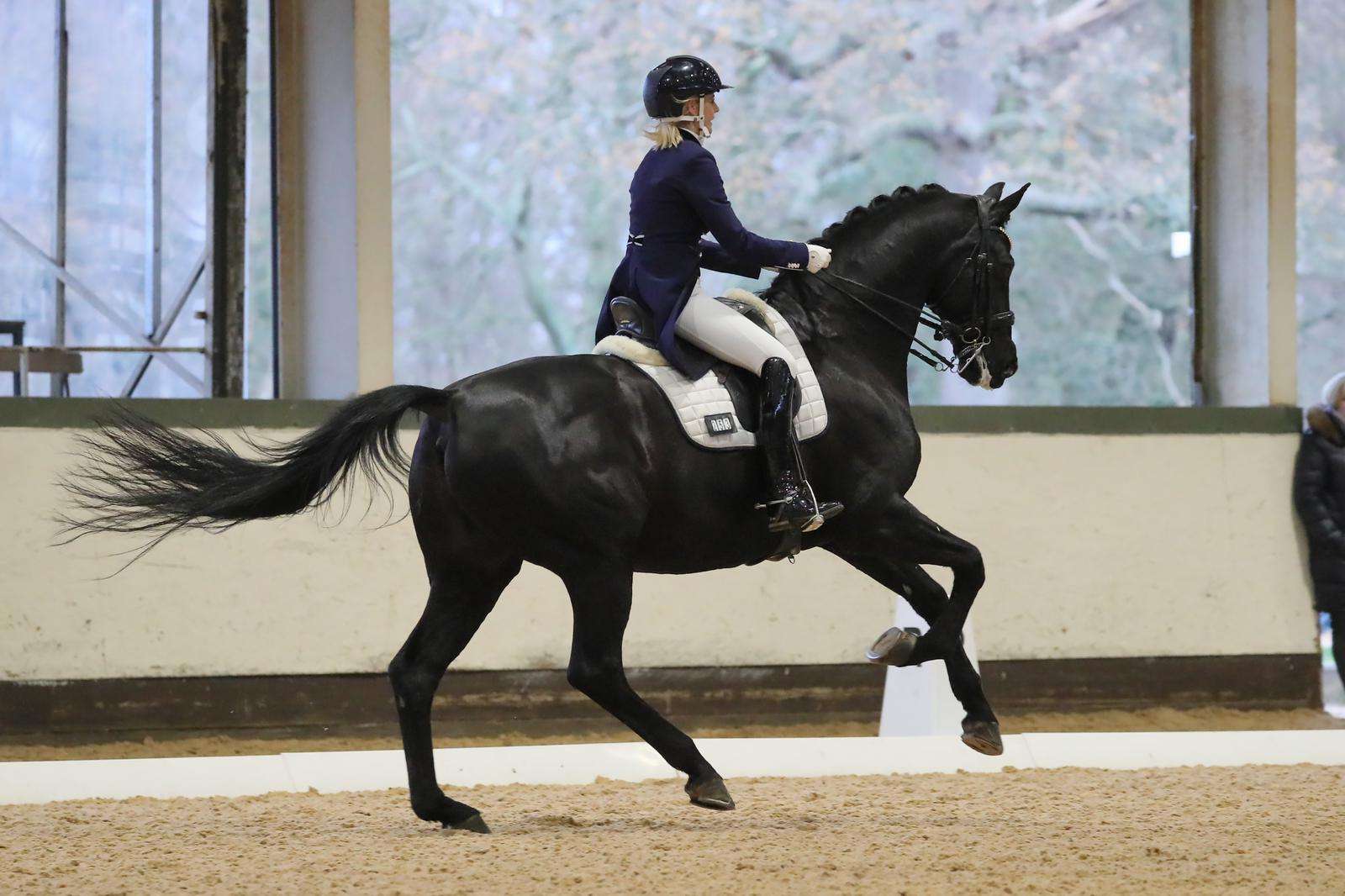
Passage and piaffe are the clearest examples: both require the wheelbase to shorten dramatically while the topline remains elastic, the back swinging, and the shoulders upright. Without that, the piaffe becomes stuck and passage becomes wallowy. When the loop is intact, these movements are simply a more condensed version of the same throughness seen at Small Tour — not a different language, but a more compressed dialect of it.
The same is true of the canter work. At Small Tour, the balance for tempi changes is tested in threes and fours, where the horse’s ability to recycle energy forward while staying straight is the priority. At Grand Prix, the one-tempi sequence exposes whether straightness and collection can survive under maximum pressure. Every stride becomes a rebalance. If rhythm or suppleness falter, the line disintegrates. Done correctly, the one-tempis are not about speed, but about the horse’s ability to sit and “pass the ball back” to the rider stride after stride, like a metronome under power.
Biomechanically, the difference is in how weight is managed. At Small Tour, equal distribution across all four feet is still a work in progress; the horse can show moments of lightness, but often still leans into scope and forward intent to help. At Grand Prix, the horse must be perfectly balanced, with the thoracic sling lifting the forehand and the topline recycling energy continuously.
The training scale at Grand Prix becomes a test of how completely the horse has been developed as an athlete: symmetrical, resilient, and able to sustain load without bracing.
The real progression then is not that Grand Prix horses “learn more tricks.” It is that the foundation built in the Small Tour — rhythm, suppleness, connection — has been deepened to such a degree that impulsion, straightness, and collection emerge as natural by-products.
Passage and piaffe are simply the highest expressions of suppleness over the back and a shortened, organised wheelbase. One-tempis are simply the most refined expression of straightness under power.
Grand Prix is not separate from the scale; it is the scale made visible at its highest resolution.
For the rider, this means the focus cannot just be on movements. It must remain on keeping the loop alive: rhythm that never blurs, suppleness that is spinal not cosmetic, and connection that organises the whole body, not just the head and neck. Do that and the difference between Small Tour and Grand Prix stops being a cliff edge. It becomes a continuous line of development with the horse gradually learning to carry more, recycle more, and shape its own body with you, until collection becomes effortless harmony.

Leave A Comment
You must be logged in to post a comment.