
When we strip dressage back to its essence, we must separate two very different practices:
- flat work as a rehearsal of movements, and
- dressage as the gymnastic training of the horse.
One is choreography. The other is transformation.
Flat work, in its simplest form, is about “doing the movements.” A half-pass is asked, a pirouette is mapped out, a test is practised.
Yet if these are ridden on a horse that is stiff through the ribs, uneven in the shoulders, or braced across the back then nothing is achieved beyond the shape on the sand. The horse is no different at the end of the ride than at the beginning.
True dressage works deeper. It is not about placing the horse into positions but about creating symmetry and throughness through the whole body.
When a horse becomes truly gymnastic, energy flows in a circle from the hind limbs, forward through the back, lifting into the topline, travelling through the neck into the hand, and returning back into the body. This circular energy is the living pulse of dressage — without it, no movement has meaning.
Dressage: Physiotherapy For The Horse
Dressage, correctly applied, functions like physiotherapy. Every exercise is a mobilisation of joints, a lengthening of muscles, and a balancing of asymmetries.
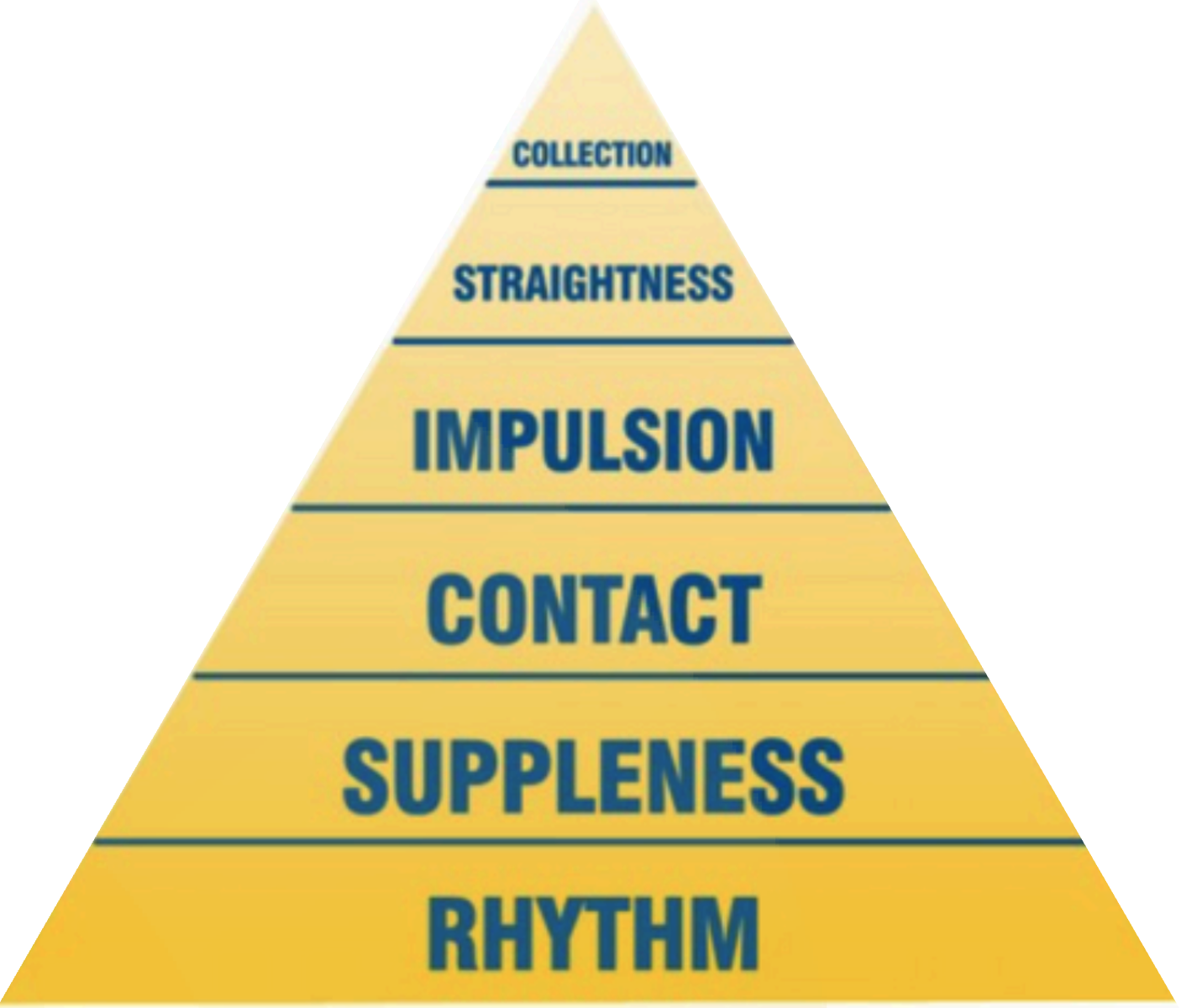
By lengthening the topline and shortening the wheelbase, the horse finds a posture where the spine can move freely, the shoulders remain upright, and each foot bears its fair share of weight. This is what the training scale creates — a harmonious balance in all four feet where energy can recycle through the horse’s frame without leakage.
Why does this matter for soundness? Because imbalance is the enemy of longevity. A horse that braces in the back or collapses to one shoulder over-uses some joints and under-uses others. Over time, those patterns lead to strain, uneven muscle development, and eventual breakdown. On the other hand, a horse that works through distributes forces evenly. No joint or muscle is overloaded; tissues stay elastic, circulation improves, and the horse remains supple.
Veterinary physiotherapists often remark that application of the training scale — transitions, shortening and lengthening, symmetry etc — mirror the same mobilisations they prescribe for rehabilitation. Dressage, in this sense, is structured physical therapy, done daily, with artistry layered over science.
The Half-Pass Example
Take the half-pass.
In flat work, it is often treated as a sideways line from point A to point B. But without true throughness, the shoulders will drift, the inside hind will slide out behind, and the horse simply “draws a line” across the arena.
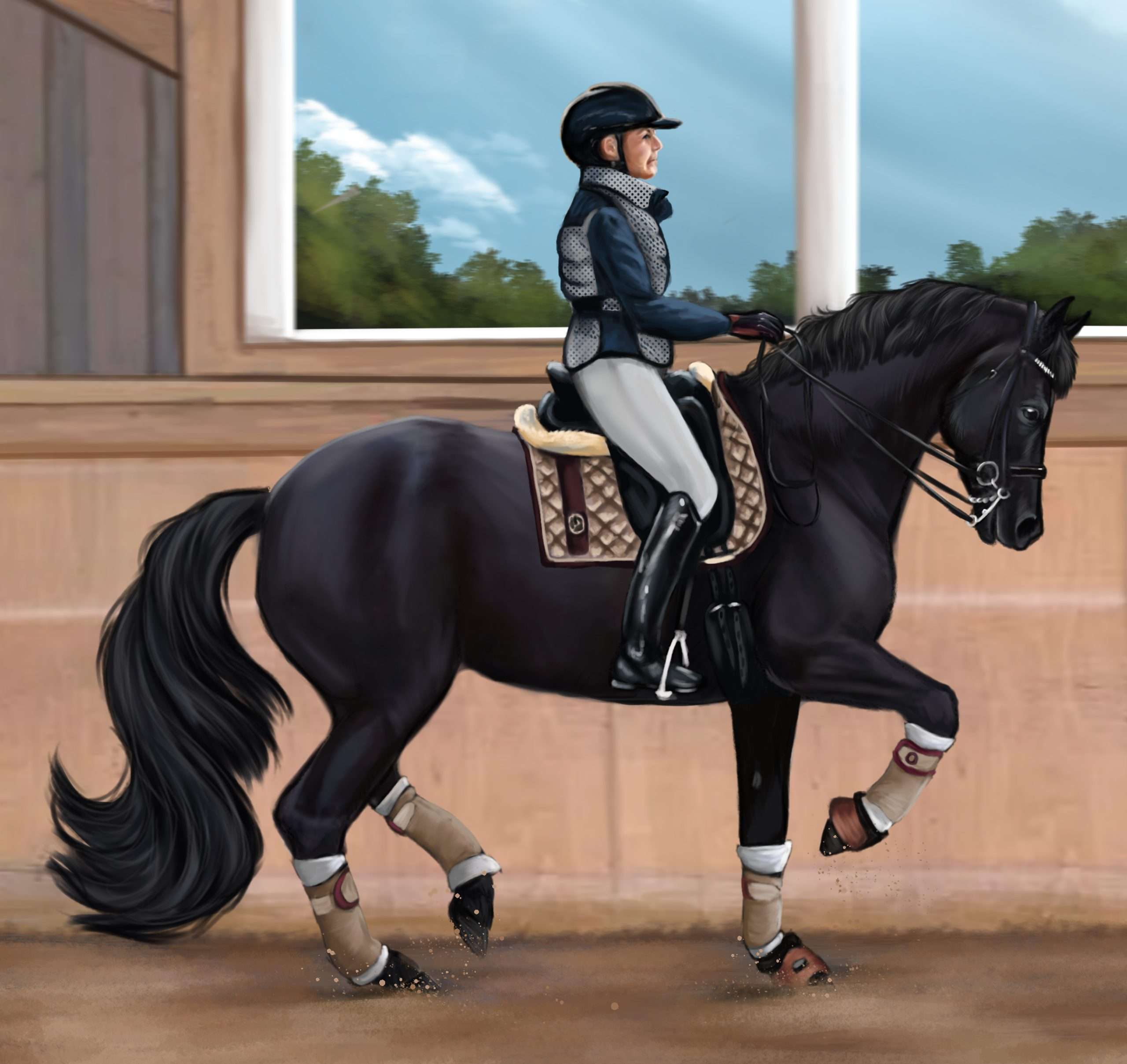
In gymnastic dressage, the half-pass is not sideways at all — it is forward, elastic, and symmetrical. The topline remains long, the wheelbase stays short, and the shoulders travel upright in front of the hips. The energy flows in the same circle as in straight work: through the back, into the hand, back to the body. The “sideways” element is simply a shape layered on top of that balanced energy.
Why This Approach Preserves The Horse
A gymnastic horse, trained with symmetry and throughness as the goal, will last longer. He is easier to ride because his body works with you instead of against you. He is healthier because every stride functions as conditioning. He is happier because the work releases tightness instead of creating it.
By contrast, a horse trained only in movements may look dazzling for a season (to the untrained eye), but the foundation is brittle. Without the circle of energy, the body is not truly connected and sooner or later, resistance, lameness, or breakdown follows.
The Rider’s Task: Daily Questions for True Dressage
Every stride is an opportunity to check if you are building gymnastics or just rehearsing shapes.
Each stride is a conversation. The goal is not to hold the horse in place, but to keep the dialogue alive with micro-adjustments.
- Is there true symmetry? (LOF – organisation of the shoulders)
- Do both reins feel even?
- Are the shoulders upright and in front of the hips?
- Am I clear on my line? (LOF – line)
- Is the horse travelling as if between two train tracks, without one shoulder leaking?
- Every stride, re-choose the line: The quality of the line keeps the body honest.
- Is the energy flowing forward with intent? (LOF – forward intent)
- If I stopped riding for one stride, would the horse keep carrying me forward, or would the energy fade? Forward intent is not speed — it’s the horse taking you.
- Do I feel lift and lightness? (ELE – Alicia’s Elevation Edge)
- Is there a soft upward feel – a sense of the topline lengthening and the shoulders free to rise? A small ELE adjustment — a gentle invitation to “stand tall with me” — adds that last 5% of expression and softness.
These questions matter. They are the daily compass that ensures dressage serves the horse first.
In conclusion, flat work rehearses the patterns. Dressage develops the horse. The first leaves you with shapes; the second leaves you with transformation. When we ride for symmetry, throughness, and the recycling of energy, we are not only training a dressage horse — we are preserving his body, prolonging his soundness, and elevating the art into something generous, lasting, and truly worthy of the name.
Leave A Comment
You must be logged in to post a comment.